Somewhere between Marrakech and the dunes of the Sahara, the road climbs over the High Atlas and drops back down into a different Morocco entirely — dry, ochre-colored, and dotted with fortified earthen villages that look like they were built by hand out of the landscape itself, because they largely were. The most famous of these is Ait Benhaddou, and if you're making the classic overland route from Marrakech to Merzouga, it's not a detour. It's the route — see our 7-day Marrakech to Sahara itinerary for how it fits into a full route.
What Is Ait Benhaddou?
Ait Benhaddou is a ksar — a fortified village built from rammed earth (pisé) and adobe brick, a traditional construction style found throughout southern Morocco's pre-Saharan valleys. It sits on a hillside above the Ounila River, its clustered towers and kasbah walls stacked up in layers of reddish-brown mud architecture that have barely changed in appearance for centuries. UNESCO added it to the World Heritage List in 1987, recognizing it as one of the best-preserved examples of this style of earthen fortified architecture in the region.
A handful of families still live within the ksar today, though most of the population moved to the newer village across the river decades ago as the old structures became harder to maintain and modern life pulled residents toward better infrastructure. Walking through it now, you'll pass small workshops and galleries alongside genuinely centuries-old walls — a place that's simultaneously a living community, a heritage site, and, as it turns out, one of the most filmed backdrops in the world.
Morocco's "Hollywood of Africa"
Ouarzazate, the town just down the road from Ait Benhaddou, has earned the nickname "Ouallywood" for a reason: the region's dramatic desert light, dry climate, and architecture that can double for anywhere from ancient Rome to Tibet have made it one of international cinema's go-to filming locations for decades.
Ait Benhaddou itself has appeared on screen more times than most actors. It's a well-documented filming location for Lawrence of Arabia, Gladiator, and early seasons of Game of Thrones (standing in for Yunkai), among a long list of other productions that have used the ksar's walls and surrounding terrain over the years. Ridley Scott alone has returned to the wider Ouarzazate region multiple times across his career, drawn by exactly the qualities that make it a striking travel destination too.
Just outside Ouarzazate, the Atlas Film Studios — among the largest film studios in the world by land area — has hosted productions ranging from historical epics to sci-fi blockbusters, with elaborate sets (Egyptian temples, Tibetan monasteries, ancient city walls) that sometimes stay standing long after filming wraps. Several studio complexes in the area are open to visitors, offering a genuinely fun look at how these sets are built and reused across different films.
Why It's a Waypoint, Not a Standalone Trip
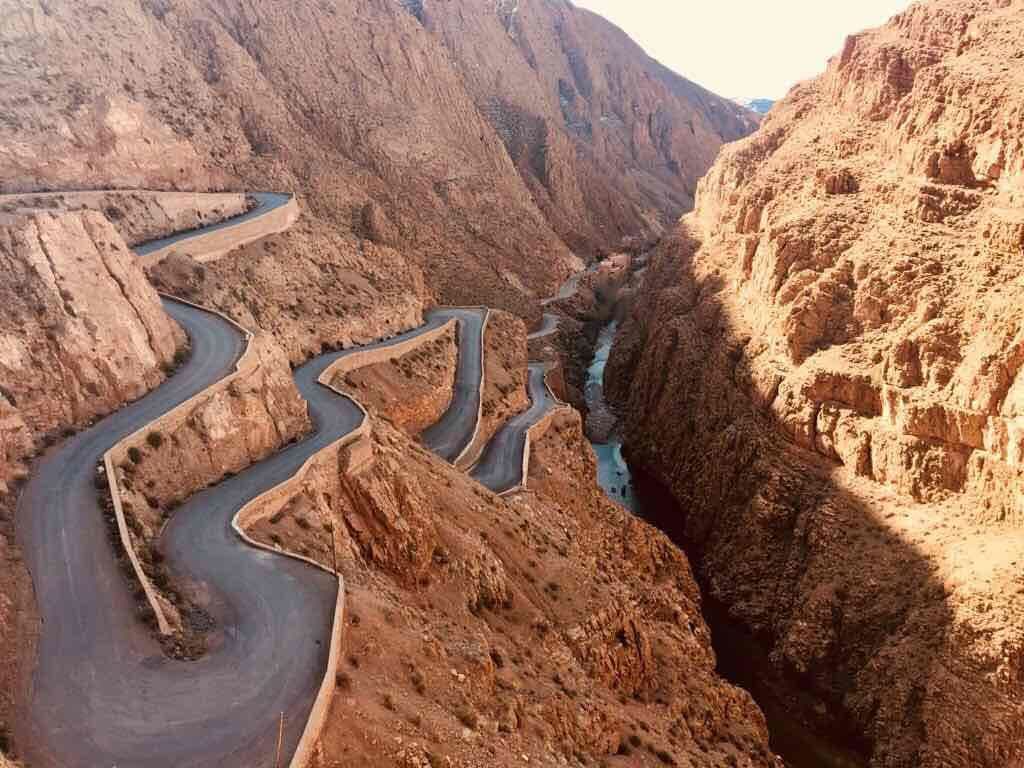
Here's the practical reality: Ait Benhaddou isn't really a destination people fly in specifically to see on its own. It's a stop — an essential one — on the classic overland route between Marrakech and the Sahara. That route climbs out of Marrakech over the Tizi n'Tichka pass, the highest major mountain pass in the Atlas accessible by paved road, with switchbacks and views over Berber villages terraced into the mountainside. From the pass, the road descends into the pre-Saharan valleys, reaching Ait Benhaddou and Ouarzazate before continuing on toward Dades Gorge, Todra Gorge, and eventually the dunes near Merzouga.
Because of where it sits geographically, Ait Benhaddou works best as a stop on a multi-day desert-bound itinerary rather than something you'd carve out a separate special trip for. Most travelers see it mid-morning or around lunchtime on their way south, climb up through the ksar's narrow passages to the ruined agadir (fortified granary) at the top for the panoramic valley view, and continue on the same day toward the next overnight stop.
What to Expect When You Visit
Plan for an hour or two on-site — enough time to cross the river (via stepping stones or a small footbridge, depending on water levels), wander up through the ksar's narrow lanes past small shops selling local crafts and sand paintings, and climb to the top for the view before continuing your journey. The uphill walking is on uneven earthen surfaces, so comfortable shoes matter more here than in most towns you'll visit in Morocco.
If your schedule allows a stop in Ouarzazate itself, the Taourirt Kasbah — another impressive earthen fortress, this one right in town — and a visit to one of the film studios make a worthwhile extension before continuing toward the gorges.
Making It Part of Your Sahara Route
On our escorted tours heading toward the Sahara, Ait Benhaddou is a built-in stop along the Marrakech–Merzouga overland route — not an optional extra you have to arrange separately, and it's exactly the kind of local knowledge that makes an escorted route worth it over self-driving. It's one of the clearest examples of why the overland route to the desert is worth taking over flying: the road itself, with its mountain passes, kasbahs, and film-set backdrops, ends up being as memorable as the dunes at the end of it.