Most people book a Sahara desert tour for the dunes, the camel trek, the sunset. The stars are the part nobody tells them to expect — and, for a lot of travelers, they end up being the single moment they talk about most when they get home. There's a specific kind of quiet that comes with realizing you can see the Milky Way with your naked eye, something the vast majority of people on earth will never experience because of where they live.
This guide covers why the Sahara is genuinely exceptional for stargazing, when to go for the best skies, and how to actually make the most of a night in camp instead of missing it because you were tired from the day's ride.
Why the Sahara Is One of the Best Places to See Stars
Two things make the difference, and they're both simple. The first is light pollution, or rather the almost total absence of it. Merzouga and the dunes around it sit far from any significant urban glow, and once you're a short walk from camp, there's nothing artificial competing with the sky. Most people who ask about the best place to see stars in Morocco are, without realizing it, really asking where they can get furthest from a city — and the Sahara answers that better than almost anywhere else in the country.
The second is atmospheric clarity. Desert air is dry, and dry air scatters and diffuses starlight far less than humid air does. Combine minimal light pollution with consistently clear, dry skies and you get nights where the Milky Way isn't a faint smudge you have to convince yourself you're seeing — it's a genuinely bright band arcing overhead, with individual dust lanes visible if you give your eyes time to adjust.
Best Time of Year for Sahara Stargazing
Clear skies are more consistent in the cooler, drier months — roughly November through February — when humidity is lower and cloud cover is rare. That said, any month can deliver an exceptional night if conditions line up, and the desert's dryness means even the warmer months rarely disappoint the way a humid climate would.
The detail that matters more than the month, though, is the moon phase. A full moon is bright enough to wash out fainter stars and the Milky Way's detail, even in a place as dark as the Sahara. If stargazing is a priority for your trip, try to time your desert night around a new moon or a slim crescent — check the lunar calendar before you book, not after you arrive. A bright moon still makes for a beautiful, silver-lit dune landscape, just a different experience than a true dark-sky night.
What You Can Actually See
On a clear, dark night away from camp lighting, expect to pick out the Milky Way's band clearly with the naked eye, along with far more individual stars than most people have ever seen at once — city skies typically show a few hundred at most; a genuinely dark desert sky can reveal several thousand. Shooting stars are common enough that spending twenty or thirty minutes lying back and watching will usually turn up at least a few. Depending on the season, planets like Venus, Jupiter, or Saturn are often visible as notably bright, steady points of light, distinguishable from stars by the fact that they don't twinkle.
You don't need a telescope to have a genuinely memorable night. Binoculars, if you happen to have a compact pair, add a nice layer of detail — they'll resolve individual stars in denser clusters and pull a bit more definition out of the Milky Way — but plenty of travelers have their best stargazing night of the trip with nothing but their eyes and a blanket in the sand.
Practical Tips for a Proper Stargazing Night
Get away from camp light. Even the relatively modest lighting around a desert camp is enough to dull your night vision. A five-minute walk to a quiet dune away from the fire and any lanterns makes a real difference.
Give your eyes time to adjust. Full dark adaptation takes 20-30 minutes. Resist the urge to check your phone during that window — even a quick glance at a bright screen resets the adjustment and you'll have to start over.
Dress for the cold. This catches people off guard more than almost anything else about the desert: nights are cold, even after a hot day, and lying still on sand for an extended stretch gets cold fast. Bring a proper layer, not just what you wore during the camel trek — see our full desert packing list for exactly what to bring.
Efforts like the International Dark-Sky Association exist precisely to protect nights this dark from disappearing — a reminder of how rare a sky like the Sahara's has become.
If you're attempting astrophotography, a tripod is close to essential — handheld night shots won't work — and a wide-angle lens with a fast aperture will capture far more of the sky and Milky Way detail than a standard zoom. Longer exposures (typically 15-25 seconds) will pick up detail invisible to the naked eye, though even a simple phone in night mode on a stable surface can produce a surprisingly good result these days.
Making It Part of Your Trip
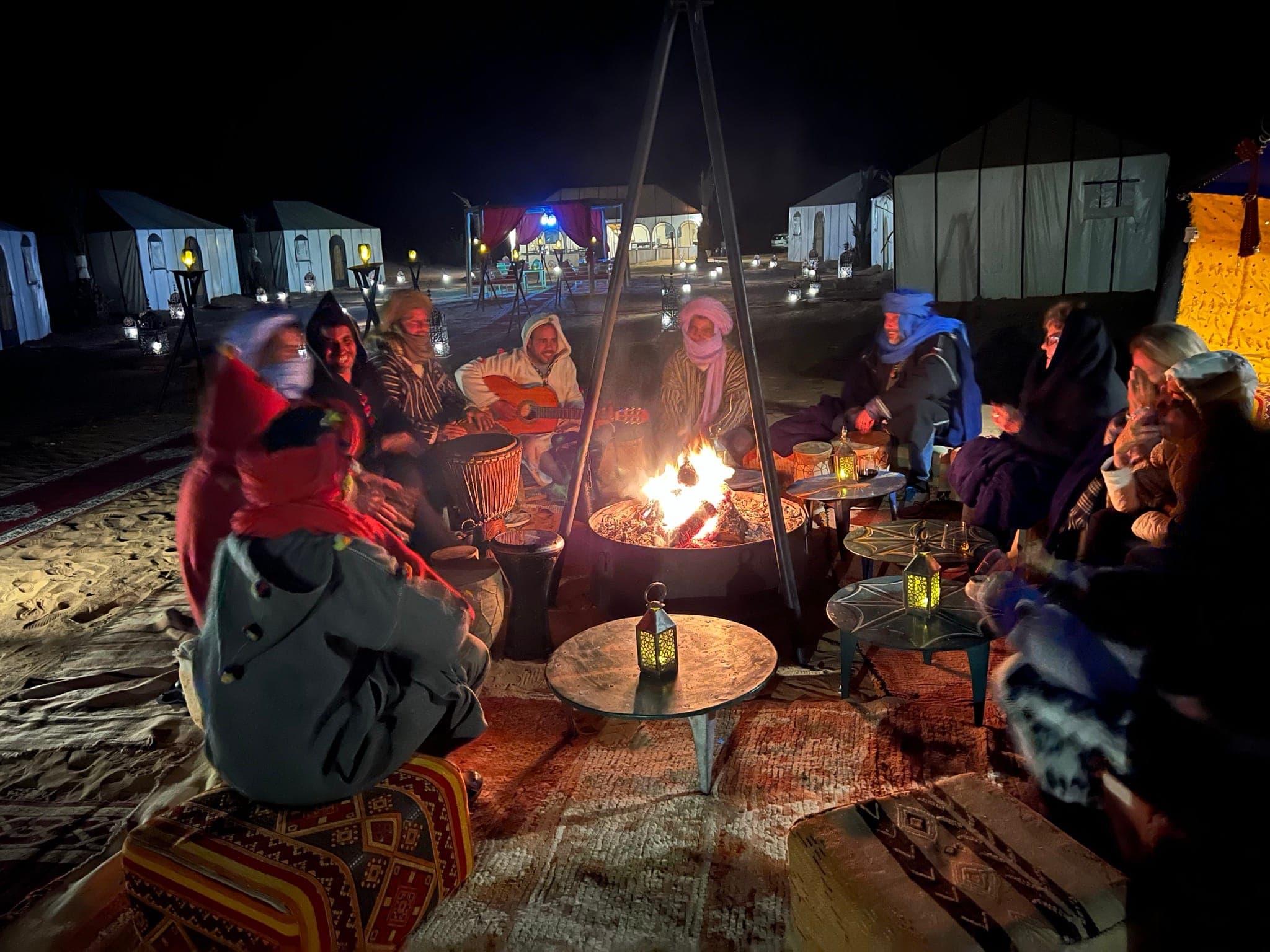
Stargazing isn't something you need to schedule separately — it's simply what happens after dinner, once the fire's traditional music winds down and the camp quiets. The dunes themselves make a natural amphitheater for it: walk a short distance from the tents, find a spot on a rise, and the sky does the rest. It's one of the simplest parts of a Sahara night and consistently one of the most talked-about afterward.
If a clear-sky night is a genuine priority rather than a nice bonus, mention it when you book one of our escorted Sahara desert tours — we can help time your desert night around the lunar calendar so you're not left hoping the moon phase cooperates by chance.